BMI calculator
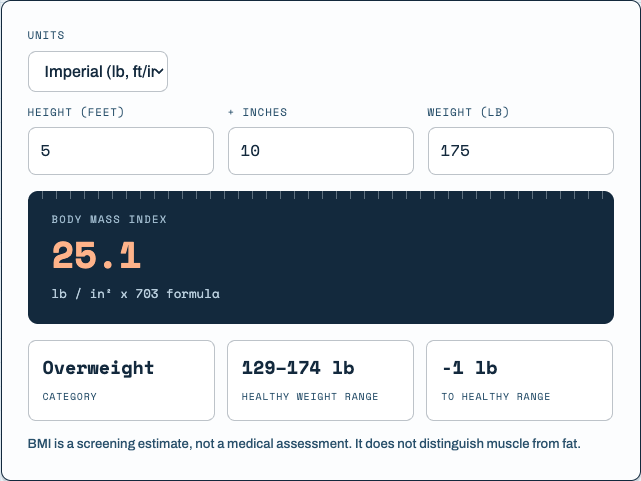
Height and weight in, BMI and category out, plus the weight range considered healthy for your height.
BMI is a screening estimate, not a medical assessment. It does not distinguish muscle from fat.
What to do with the number once you have it
A single BMI reading is a coarse screen, and the most useful way to hold it is as a trend rather than a verdict. The number moving from 27 to 25 over a year tells you something real about direction; the difference between 24.8 and 25.2 on one Tuesday tells you almost nothing, since a large glass of water moves you a measurable fraction of a point. If you weigh in, do it under repeatable conditions, same time of day, same state of dress, and compare against your own history instead of fixating on a category boundary.
The "To healthy range" stat is deliberately modest: it shows the distance to the nearest edge of the range, not to some ideal midpoint. That framing is worth adopting. Reaching the edge of the range is a meaningful, measurable milestone, and health outcomes improve along the way, not only at the boundary. People who set the range's edge as the goal, rather than a number from their early twenties, tend to set targets they can actually reach.
One measurement tip that changes results more than people expect: use your real current height, measured, not remembered. Height gets rounded up in self-reports and also genuinely decreases with age, and because height enters the formula squared, an inch of flattery lowers your calculated BMI by roughly 0.7 of a point.
A worked reading
Take someone 6 feet 2 inches at 210 pounds. Their height is 74 inches, or 1.8796 meters, and their weight converts to 95.25 kilograms. BMI is 95.25 divided by 1.8796 squared, which comes out to 27.0, in the overweight category. The healthy range for that height displays as 144 to 194 pounds, and the distance stat reads -16 lb, the gap to the top of the range. The same person entered in metric at 188 cm and 95.3 kg produces the same 27.0, since both unit systems feed one formula.
How the calculation runs
Whatever units you choose, the calculator converts to kilograms and meters internally with exact conversion factors, then computes weight over height squared. The familiar imperial version, pounds over inches squared times 703, is the same identity with the conversions baked into that one constant, which is why the caption under the result shows it when you work in pounds and feet. The category thresholds are the WHO adult cut-points, and the healthy weight range is that same formula solved backwards: 18.5 and 24.9 times your height in meters squared, converted back to your units. Results round to one decimal, and the distance-to-range stat only appears with a direction sign when you are outside the range; inside it, it simply says so.
The honest fine print
BMI was built to describe populations, and it screens individuals imperfectly. Beyond the muscle-versus-fat problem, it cannot see where weight is carried, and abdominal fat carries different health implications than the same pounds elsewhere, which is why clinicians often pair BMI with a waist measurement. Some populations face higher metabolic risk at BMI values below the standard cutoffs, and the standard adult thresholds do not apply to children, during pregnancy, or reliably in older adults. None of that makes the number useless; it makes it one input. If your reading lands somewhere that worries you, the next step is a conversation with a clinician who can look at more than two numbers.
Frequently asked questions
How is BMI calculated?
Weight in kilograms divided by height in meters squared. In imperial units the formula is weight in pounds divided by height in inches squared, times 703. A 5'10" person at 175 lb has a BMI of 25.1.
What are the BMI categories?
The WHO adult ranges: under 18.5 is underweight, 18.5 to 24.9 is the healthy range, 25 to 29.9 is overweight, and 30 or above is obese.
Is BMI accurate for everyone?
No. It cannot tell muscle from fat, so muscular people often score "overweight" while lean, and it is not designed for children, pregnancy, or adults over 65. Treat it as a population screening number, not a diagnosis.
What is a healthy weight for my height?
The range that puts BMI between 18.5 and 24.9. This calculator shows that range in your chosen units as soon as you enter a height.