Loan calculator
Amount, rate, term. Get the monthly payment, the total interest over the life of the loan, and what an extra monthly payment saves.
Reading your result like a lender does
The monthly payment is the least informative number on the page. Lenders and finance-savvy borrowers look at total interest, because that is the actual price of the loan. A $20,000 loan at 7% costs $3,761 over five years but $7,866 over ten: same money borrowed, double the price, in exchange for a payment that feels $164 lighter each month.
Two levers move total interest, and they are not equal:
- Term is the big one. Shortening a 10-year loan to 5 years cuts interest roughly in half. If the shorter payment fits your budget, it is the single best deal in consumer finance.
- Rate matters more as balances grow. One percentage point on $20,000 over 5 years is about $570; on a $300,000 mortgage over 30 years it is about $72,500. Shop rates hard on big loans, less obsessively on small ones.
The extra-payment field above shows the third lever: prepayment. Every extra dollar retires principal immediately, deleting all future interest that dollar would have generated. On long loans, modest extra payments early beat large ones late, because early dollars have more future interest to delete.
A worked example with the extra payment
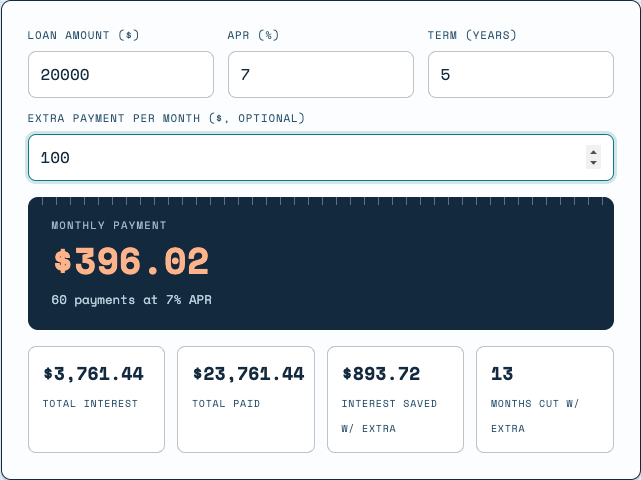
Take the default loan on this page: $20,000 at 7% APR for 5 years. The formula gives a payment of $396.02 a month and $3,761.44 of total interest. Now put 100 in the extra payment field. The simulation pays $496.02 each month, applies the surplus to principal, and the loan finishes in 47 months instead of 60. Total interest drops to $2,867.72, a saving of $893.72 for a habit that costs about the price of one streaming bundle per month. Run your own numbers rather than trusting these: the point of the calculator is that the answer changes a lot with rate and term.
How this calculator does the math
The base payment uses the standard amortization formula that lenders use, with your APR divided by 12 as the monthly rate. The extra payment result is not a formula at all. The calculator simulates the loan month by month, charging interest on the remaining balance and applying your payment against it, until the balance reaches zero. That is why the months figure comes out as a whole number and the final month is usually a smaller payment. While building this site I checked the outputs against an independent amortization calculation written separately in Python; the defaults above match to the cent.
What this does not include
This is a fixed rate simple amortization model. It does not model origination fees, so a loan advertised with a fee will have a true APR above its stated rate. It does not handle variable rates, balloon payments, or interest capitalization from deferment periods, which matter for some student loans. And it assumes your extra payment is applied to principal immediately, which is standard for most lenders in the US but worth confirming with yours, since a few hold extra amounts toward the next payment instead unless you tell them otherwise.
Frequently asked questions
How is the monthly loan payment calculated?
With the standard amortization formula: payment = P x r / (1 - (1 + r)^-n), where P is the amount borrowed, r the monthly rate (APR / 12), and n the number of monthly payments. A $20,000 loan at 7% APR over 5 years comes to $396.02 a month.
Why is total interest so high on long loans?
Early payments are mostly interest because the balance is still large. Stretching the same amount over more years lowers the monthly payment but multiplies the months you pay interest on a slowly-shrinking balance.
How much do extra payments actually help?
Every extra dollar goes straight to principal, which removes all the future interest that dollar would have accrued. Enter an extra monthly amount to see months cut and interest saved on your exact loan.
Is APR the same as interest rate?
APR includes mandatory fees rolled into the yearly cost, so it is the honest comparison number. This calculator treats your input as the yearly rate compounded monthly, which matches how lenders quote most consumer loans.