Mortgage calculator
The real monthly number: principal and interest plus taxes, insurance, and HOA, not just the loan math.
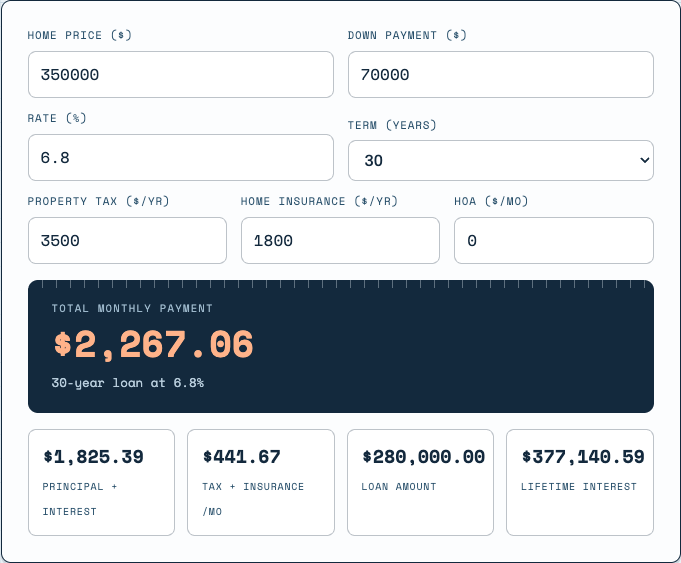
The numbers under the payment
The lifetime-interest figure above surprises most first-time buyers: on a typical 30-year loan it exceeds the amount borrowed. That is not a scam, it is compounding working against you across 360 payments, and it is why the 15-versus-30-year decision is worth real thought. A 15-year term roughly halves lifetime interest twice over: the term is half, and 15-year rates typically run about half a point lower.
What lenders check that this calculator can preview: the 28/36 rule. Housing costs (the PITI number above) should stay under about 28% of gross monthly income, and all debt payments combined under 36%. If the total monthly figure here is more than 28% of your gross monthly pay, expect the loan officer to squint.
Costs this calculator deliberately leaves out, so budget for them separately: closing costs (typically 2-5% of the loan, due at signing), PMI if you put down less than 20% (the warning appears above when that applies), HOA increases, and maintenance, for which the standing rule of thumb is 1% of the home's value per year.
Reading the four stats before falling in love with a listing
The headline payment is what fits or does not fit your monthly budget, but the four figures beneath it each answer a different question. Principal and interest is the part fixed for the life of the loan; it is the only slice a refinance can shrink. The tax-and-insurance slice is the part that will drift upward over the years no matter what your loan documents say, because assessors reassess and insurers reprice. The loan amount confirms what you are actually financing after the down payment. And lifetime interest is the price tag of the financing itself, the number to compare across scenarios.
Use the calculator as a scenario machine, not a one-shot answer. Change one input at a time and watch which lever actually moves the payment. Rate moves it more than most buyers expect: on a $280,000 loan, small rate differences compound across 360 payments, so a quarter point is worth shopping multiple lenders to find. Price moves it less than feelings suggest: the difference between a $350,000 and a $360,000 house is a far smaller monthly change than the difference between two lenders' rate quotes.
One non-obvious input tip: get the property tax figure from the county's actual bill for that specific house, not from a state average. Two houses on the same street can carry different assessed values, and a recently sold home is often reassessed upward to its sale price, making the seller's old tax bill an underestimate of yours.
The default scenario, verified
Take the numbers preloaded above: a $350,000 home with $70,000 down, 6.8% for 30 years, $3,500 yearly tax and $1,800 insurance. The loan is $280,000. The amortization formula at a monthly rate of 6.8% / 12 over 360 payments gives principal and interest of $1,825.39. Tax and insurance add $5,300 / 12 = $441.67 a month, for a total payment of $2,267.06. Lifetime interest comes to just over $377,000, which is more than the amount borrowed, the standard sticker shock of a 30-year term. Since $70,000 is exactly 20% down, no PMI warning appears; drop the down payment to $60,000 and it will.
What the formula includes and how
Principal and interest use the same amortization formula lenders use: loan amount times the monthly rate, divided by one minus (1 + monthly rate) raised to the negative number of payments. A 0% rate falls back to simple division, so the tool cannot divide by zero. Property tax and insurance are entered as yearly amounts and split into twelfths, mirroring how an escrow account collects them, while HOA dues are taken as already monthly. The PMI hint is a threshold check on down payment over price, deliberately shown as a warning rather than folded into the payment, because actual PMI pricing varies too much by credit score and lender to fake a number.
Assumptions that will not survive contact with a real closing
This models a fixed-rate loan, so adjustable-rate mortgages, buydowns, and interest-only periods are outside it. The escrow slice is frozen at today's figures, but taxes and premiums rise, meaning the total payment in year ten will be higher than the number above even though principal and interest never move. PMI, when it applies, is excluded from the total by design. And the payment says nothing about the cash needed to get the keys; treat the monthly figure and the closing-table figure as two separate tests a purchase has to pass.
Frequently asked questions
What does PITI mean?
Principal, Interest, Taxes, Insurance: the four parts of a real monthly housing payment. Lenders qualify you on PITI, not just the loan payment, which is why this calculator includes tax and insurance fields.
How much down payment do I need?
Conventional loans allow as little as 3% down, but below 20% most lenders add private mortgage insurance (PMI), commonly 0.3% to 1.5% of the loan per year. This calculator flags when your down payment is under 20%.
How do I estimate property tax?
US property tax averages around 1% of home value per year but ranges from about 0.3% (Hawaii) to over 2% (New Jersey, Illinois). Your county assessor website lists the actual rate; enter the yearly dollar amount here.
Does a 15-year loan really save that much?
Yes: the rate is usually lower and interest accrues for half as long. On a $300,000 loan, moving from 30 years at 7% to 15 years at 6.4% roughly halves the total interest, in exchange for a higher monthly payment.